

performing the drawing-in maneuver or bracing can do what?
The myth of core stability: In this web log commodity you lot will acquire why we demand to cease blaming a weak or "unstable" core for low back pain and why the whole thought of a weak or "unstable" cadre is based on outdated research ideas.
"Yes, you lot have a weak cadre, you gotta do core stability exercises man". If we had received one cent per time that a weak or unstable cadre had been blamed for a patient's low back pain in the health or fitness industry, we would surely be millionaires past now. In this blog, nosotros will have a look back in time to see where the idea of an unstable core came from and discuss why the concept is BS.
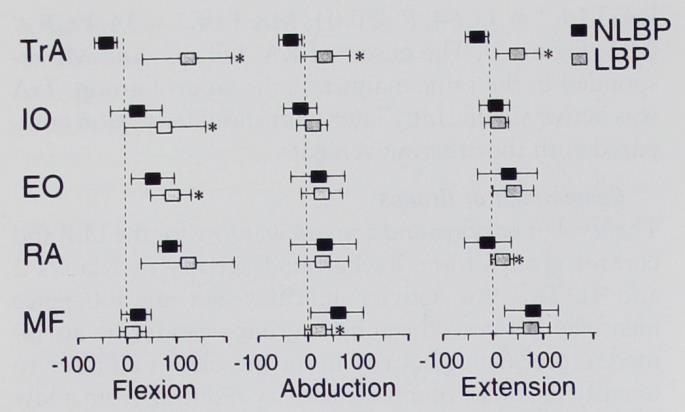
Almost 25 years ago, Hodges et al. conducted a written report in which they establish a delayed onset of contraction of the transverse abdominis of 50 milliseconds when patients with chronic low back pain raised their contralateral arm compared to a healthy group.
This paper has triggered the core stabilization craze that we are still seeing in the wellness industry today. In short, the concept was born that the deep stabilizers, namely the transverse abdominis and the multifidi would human activity as a corset to stabilize the lumbar segments around mid-range, which was termed „neutral zone". In 2008, withal, a report by Alisson et al. measured the transverse abdominis bilaterally and found that both sides act independently. And so the left side contracts when yous raise your right arm and the other way round. They concluded that the TrA does non act every bit a corset and that the idea of the muscle as a bilateral stabilizer needs to exist revised.
Assessment
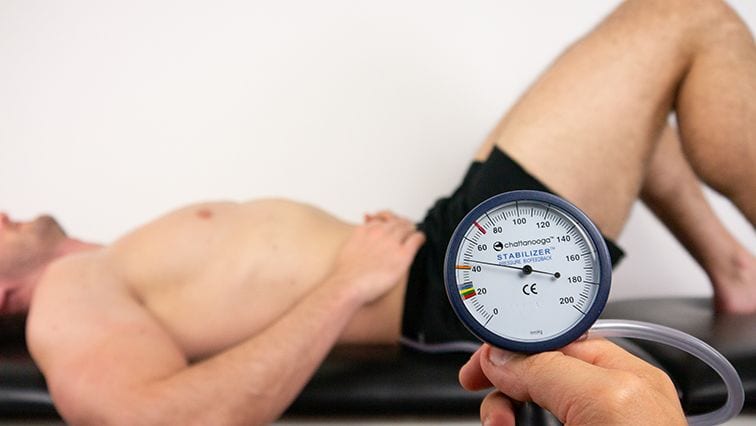
Anyways, let's presume that the function of the TrA is still that of a stabilizer of the lumbar spine. While this delayed muscle onset was measured in a laboratory setting, nosotros will accept to ask ourselves if we can observe this „dysfunction" in the clinic. In practise, the pressure biofeedback unit was invented to make up one's mind the function of the TrA and multifidi. Simply how accurate is this measure really? Lima et al. In the twelvemonth 2022 compared the validity of the force per unit area biofeedback unit to electromyography and institute a very poor diagnostic accurateness with both sensitivity and specificity of threescore% – and then we are not talking near the delayed onset of contraction, but just A contraction of the muscles.
What about motility control tests? Luomajoki et al. (2007) Showed that a test battery of 6 different tests had a substantial intra- and inter-rater reliability. If yous're curious about the bombardment, check out the video in the acme right corner. While these tests are reliable, we don't know if they are too valid: In other words, how practise patients with low back pain perform these tests compared to subjects without hurting? And even if there was a marked difference between groups, how practice we know if those motility "flaws" are relevant to the persistence of back hurting?
We know that people move differently in pain and it could very well be that this contradistinct movement strategy is an result rather than the cause of hurting.
Handling

Simply let'due south go on and assume that the TrA has an important stabilizing part and that nosotros tin accurately detect patients with a delayed onset of contraction in the TrA and multifidi. What then happened in do is that we started to perform grooming for those muscles in either supine or four-betoken kneeling position. But how is forcefulness preparation gonna fix the timing issue? Lederman in 2008 compares that to trying to play to piano faster by exercising with finger weights and performing push-ups. On top of that how is being able to perform a draw-in maneuver in a supine position going to carry over to activities of daily living? The idea to railroad train those muscles in a supine or kneeling position with dull speed contradicts the principle of specificity and similarity or transfer. The but affair that would make sense is to railroad train the speed of movement and to hope that the system volition somehow reset itself.
To overcome this event, proponents of core stability came up with the solution to teach everyone to continuously brace their cores in order not to have to worry about onset timing. This proposal is completely abnormal and not how our nervous organization works. Bear witness me 1 patient who is consciously co-contracting voluntarily all the time – information technology's not possible because our nervous system wants to perform a task and then organizes muscle activity to achieve that task and not the other way round. This is like driving in contrary all the fourth dimension. That's the aforementioned reason why most patients take such difficulty performing a proper draw-in maneuver. Non certain if you are like me, but I always hated to give this practice to patients considering I knew it would be super weird and over-complicated to explain this do to patients and they would frequently not be able to do it fifty-fifty if I tried with different cues or the pressure level biofeedback unit.
At terminal, we'd similar to add that increased co-contraction of the trunk muscles happens involuntarily in a lot of patients with depression back pain. The low dorsum pain researcher Kjartan Vibe Fersum said the following (and we stole this from Jarod Hall's lecture on the topic by the style) „If people in hurting walk like a plank, maybe don't put them in a plank".
To make the story short, research has then too shown that training does not improve feed-frontwards activation of deep abdominal muscles (Vasseljen et al. 2022, Allison et al. 2022)
Okay, so now let's say that unless all that we've stated earlier, nosotros would be able to alter the onset timing of the TrA and multifidi – does it even affair?
Credits to Jarod Hall again for assembling the following list of studies who take shown that:
- No clan between alter in onset an LBP (Vasseljen et al. 2022)
- Spine stabilization exercises in the handling of chronic depression back pain: a good clinical issue is non associated with improved abdominal musculus office (Mannion et al. 2022)
- Wong et al. (2014) – systematic review: changes in morphometry or activation of transversus abdominis post-obit conservative treatments tend not to be associated with the respective changes in clinical outcome
If nosotros look a scrap broader than just the TrA or multifidi Steiger et al. (2012) performed a systematic review looking at dissimilar target aspects of performance and their influence on treatment outcomes for low back pain. They plant that the treatment effects could Not be attributed to any modify in the musculoskeletal system such as mobility, force, or endurance.
This was to expect because there are no simple solutions to circuitous problems. Back hurting is multi-factorial and research has shown that psychosocial factors like low, anxiety, movement-related fright, coping, workplace satisfaction, etc. All influence the prognosis.
So to sum it upwardly: one) The TrA does probably not have a corset function to stabilize the spine. 2) We are not able to accurately assess TrA or multifidi role in exercise. 3) Slow forcefulness training for the TrA or multifidi does not transfer to onset timing of contraction of those muscles and inquiry also shows that it'south non possible to alter onset timing. 4) Neither onset timing, nor strength or endurance of the TrA and multifidi are relevant for a positive upshot. If you are a regular follower this sounds a hell lot like the myth-busting we did for scapular dyskinesis, right? For all of those reasons, the very same researchers who have come upward with the concept like Hodges or who have build research on this concept like Peter O'Sullivan or Chad Cook take all moved on. If they have abandoned the concept of core stability – and retrieve for some it was a huge function of their professional person career – so tin can you!
Just we're not completely done yet and we enquire you to keep reading a little bit longer. Despite all of the reasons we have mentioned, low-load motor control exercises practice seem to be effective to improve low dorsum hurting. There is tons of research that compared core stabilization exercises with general strengthening exercises for the low back. Some of these studies past Smith et al. (2014), Saragiotto et al. (2016), Luomajoki et al. (2018), Wang (2012), Coulombe (2017) amongst others show that low-load stabilization exercises might be a tiny flake better at reducing pain at short-term simply all of them show that general strengthening is equally effective at long-term.
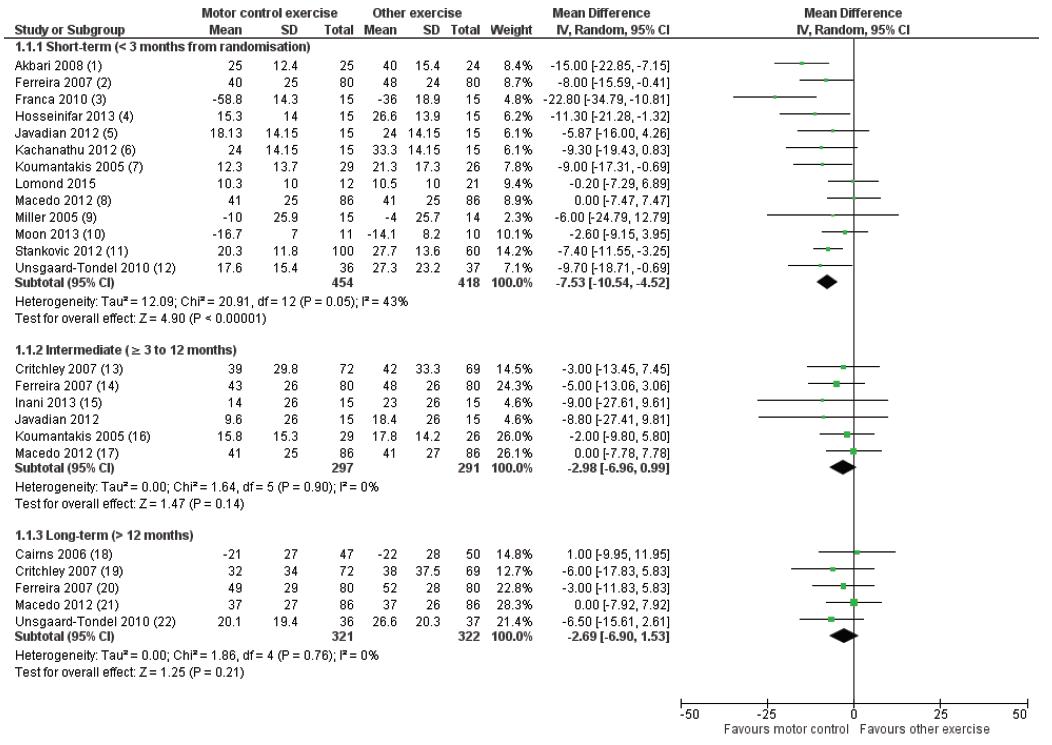
So while core stability is not the holy grail, it even so is an option for rehab. Nevertheless, this is not because the deep lumbar muscles are trained to set up an unstable spine. We remember they work because they are useful especially at the showtime of a progressive loading program of the spine. Similar to other do programs, the positive upshot is likely to be explained by aspecific effects such as diffuse noxious inhibitory control, the release of pain-reducing chemicals in your encephalon, maybe just more movement in itself, or psychosocial factors such as decreased motion-related fear, increased confidence, etc., merely in fact: Nosotros but don't know actually!
So leaving out the awkward draw in maneuvers, it'due south okay to train your pelvic tilts, dead bugs, bird dogs, Waiter's bow, and so on. Simply do them with the idea of a gradual loading programme and not with the idea to selectively activate deep muscles to stabilize the spine. If the concept of an unstable spine is explained to a patient it tin practise a lot of harm and create unnecessary worry and fright-related motion.
Okay, this was a chip of a longer blog on the myth of core stability. More than content like this on the spine can exist found on our online course "Physiotherapy of the Spine". Thanks a lot for reading!
Kai
References
Allison GT. Abdominal muscle feedforward activation in patients with chronic low back hurting is largely unaffected by eight weeks of core stability training. Journal of physiotherapy. 2022;58(iii):200.
Coulombe BJ, Games KE, Neil ER, Eberman LE. Cadre stability exercise versus general practise for chronic low back hurting. Periodical of athletic training. 2022 Jan ane;52(i):71-2.
Hodges PW, Richardson CA. Inefficient muscular stabilization of the lumbar spine associated with low back hurting: a motor control evaluation of transversus abdominis. Spine. 1996 Nov 15;21(22):2640-50.
Jarod Hall'southward Video on Dorsum Pain and Core Stability: https://www.youtube.com/sentry?v=LdukopYcBtk
Lederman E. The myth of core stability. Journal of bodywork and motility therapies. 2022 January 1;xiv(1):84-98.
Lima PO, Oliveira RR, Moura Filho AG, Raposo MC, Costa LO, Laurentino GE. Concurrent validity of the pressure level biofeedback unit and surface electromyography in measuring transversus abdominis muscle activeness in patients with chronic nonspecific low back pain. Brazilian Journal of Concrete Therapy. 2022 Oct;16(v):389-95.
Luomajoki H, Kool J, De Bruin ED, Airaksinen O. Reliability of motion control tests in the lumbar spine. BMC musculoskeletal disorders. 2007 Dec 1;eight(1):90.
Luomajoki HA, Beltran MB, Careddu South, Bauer CM. Effectiveness of movement control do on patients with non-specific low dorsum hurting and movement command impairment: a systematic review and meta-analysis. Musculoskeletal Scientific discipline and Practice. 2022 Aug ane;36:i-1.
Mannion AF, Caporaso F, Pulkovski N, Sprott H. Spine stabilisation exercises in the treatment of chronic low back pain: a good clinical consequence is not associated with improved abdominal musculus function. European Spine Journal. 2022 Jul ane;21(7):1301-10.
Saragiotto BT, Maher CG, Yamato TP, Costa LO, Costa LC, Ostelo RW, Macedo LG. Motor control exercise for nonspecific low back pain: a Cochrane review. Spine. 2022 Aug 15;41(xvi):1284-95.
Smith Exist, Littlewood C, May S. An update of stabilisation exercises for low back hurting: a systematic review with meta-analysis. BMC musculoskeletal disorders. 2022 December i;15(1):416.
Steiger F, Wirth B, de Bruin ED, Mannion AF. Is a positive clinical outcome after exercise therapy for chronic non-specific low back pain contingent upon a corresponding improvement in the targeted aspect (due south) of operation? A systematic review. European Spine Journal. 2022 Apr ane;21(4):575-98.
Vasseljen O, Unsgaard-Tøndel M, Westad C, Mork PJ. Consequence of core stability exercises on feed-forward activation of deep abdominal muscles in chronic low back pain: a randomized controlled trial. Spine. 2022 Jun 1;37(13):1101-8.
Wang XQ, Zheng JJ, Yu ZW, Bi X, Lou SJ, Liu J, Cai B, Hua YH, Wu M, Wei ML, Shen HM. A meta-assay of cadre stability exercise versus general exercise for chronic depression dorsum pain. PloS one. 2022 Dec 17;7(12):e52082.
Wong AY, Parent EC, Funabashi M, Kawchuk GN. Do changes in transversus abdominis and lumbar multifidus during conservative handling explicate changes in clinical outcomes related to nonspecific low back pain? A systematic review. The Journal of Pain. 2022 Apr ane;15(4):377-e1.

Source: https://www.physiotutors.com/the-myth-of-core-stability/
Posted by: meachamdiesse.blogspot.com
0 Response to "performing the drawing-in maneuver or bracing can do what?"
Post a Comment